
Three years of the Unitary Patent and Unified Patent Court; what do the statistics tell us?
Adoption of the UP (Unitary Patent) and UPC (Unified Patent Court) was initially cautious after their introduction in 2023, with many applicants choosing not to request unitary effect for granted European patents and opting existing European patents out of the UPC’s jurisdiction, favouring enforcement through national courts.
However, statistics recently released by the EPO (European Patent Office) suggest a gradual increase in confidence in the system.
Since 2023, patentees have been able to protect their inventions through a single patent having unitary effect across the participating EU member states, which currently number 18. Alongside this, the UPC was introduced as a single court having jurisdiction over these UPs and, subject to transitional opt-out arrangements, many ‘conventional’ European patents. The UPC therefore provides a central court for resolving patent disputes, including matters relating to infringement, validity, damages and injunctions.
This article takes a look at the trends emerging as the UP and UPC pass their third anniversary.
Absolute statistics
In absolute terms, more than 103,000 requests for unitary effect have been filed since the introduction of the Unitary Patent system three years ago, with nearly a quarter of those requests having been made so far in 2026. The highest annual total to date was recorded in 2025, when 33,300 requests were filed. It will be interesting to see whether the 2026 total surpasses that figure.
The overall uptake rate for 2026 (that is, the percentage of granted European patents for which unitary effect was requested) is currently standing at 30.8%. By the end of 2025 the equivalent figure was 28.7%, which indicates that 2026 is on track to be a record-breaking year in terms of requests filed.
The industry leaders
Since the introduction of the UPC in 2023, patentees have been faced with a choice: opt-out their European patents from the UPC’s jurisdiction, or do nothing and allow UPC jurisdiction to take effect.
There are two competing schools of thought. Many patentees prefer the certainty of an opt-out, thereby avoiding the risk of a centralised attack at the UPC. Others see significant advantages in remaining within the system. In particular, the UPC allows a patentee to seek injunctive or compensatory relief across numerous EU member states through a single action, thereby offering cost savings.
But what strategies have the industry leaders adopted?
Figure 1 shows the number of requests for unitary effect made by Samsung Group, Siemens AG, Qualcomm, Inc. and Johnson & Johnson between 2024 (the first full year of the UP) and 2026. These four companies have consistently been the highest filers of requests for unitary effect since its initiation.
Figure 1 also includes a projection for the total number of requests made by each of these companies by the end of 2026, if their current pace continues for the remainder of the year.
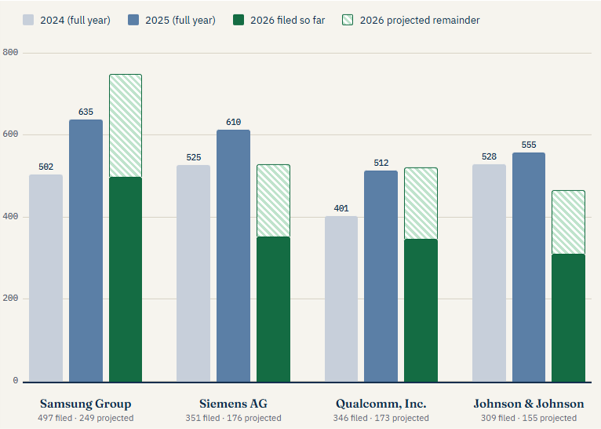
As shown, by August of 2026 Samsung has already nearly matched the number of requests it filed in 2024. If the present rate continues, Samsung is on course to exceed both its 2024 and 2025 totals before the end of the year. This is in keeping with the general trend in the computer technology and digital communication fields, which together make up a significant proportion of the total requests filed in 2026 thus far.
In contrast, Qualcomm, Inc.’s rate of request so far in 2026 is fairly consistent with that of last year, indicating no major strategy change. Both Siemens AG and Johnson & Johnson appear to have slightly reduced the number of requests being made but, again, neither suggest significant departures from last year’s strategy.
However, the above statistics should be taken with a pinch of salt – request volumes are of course heavily dependent on the number of European patents granted to each company in a given year. When viewed in that broader context, the apparent trends become even less dramatic.
While the EPO’s data for 2026 has not yet been released, what we do know is that Samsung was the leading applicant in terms of number of applications filed at the EPO in 2024 and 2025. In 2024 they filed 5107 applications, and in 2025 they filed 5337 applications. Against that backdrop, the number of requests for unitary effect has remained relatively stable, and Samsung continues to seek unitary protection for only a relatively small proportion of its overall European patent portfolio. A similar observation can be made for Siemens AG, Qualcomm, Inc. and Johnson & Johnson’s strategies so far in 2026.
Could it be that the innovation leaders are waiting for the UPC to be tested further before committing a large proportion of their portfolios to the system? It will be interesting to see whether, when the UPC builds up a more established body of case law, the strategies of today’s largest filers shift more decisively towards unitary protection.
The broader picture
While the behaviour of the above-mentioned industry leaders presents a fairly stable picture, the overall trend across all patentees shows a steady increase in interest in the UP.
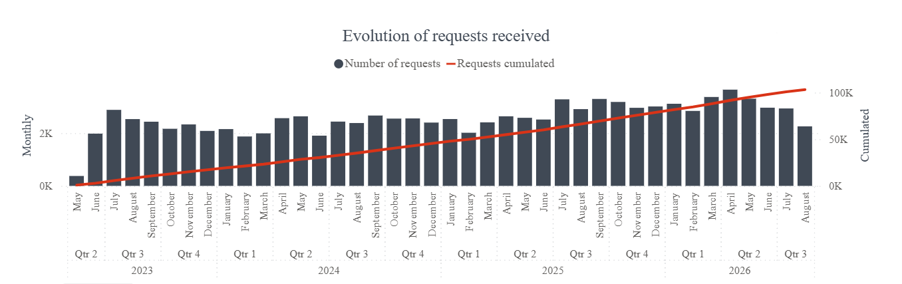
Figure taken from EPO Unitary Patent Data Desk on 28/08/2026, accessible here.
In 2023, the average number of requests filed per month was 1437. This figure has gradually risen to 3054 so far in 2026, pointing to a steady increase in confidence in the Unitary Patent system. It may be that the benefits of a centralised court are increasingly outweighing the risk of centralised attack in patentees’ minds.
So who, exactly, is leading the charge towards unitary protection?
While the overall number of requests for unitary effect continues to rise, adoption of the system is not uniform across all regions. EPO statistics show that proprietors based in EPC member states have consistently recorded the highest UP uptake rates, meaning that European-owned patents are more likely to be converted into Unitary Patents than those originating from other major filing regions.
Figure 3 illustrates how uptake rates have evolved between 2023 and 2025 across several key jurisdictions.
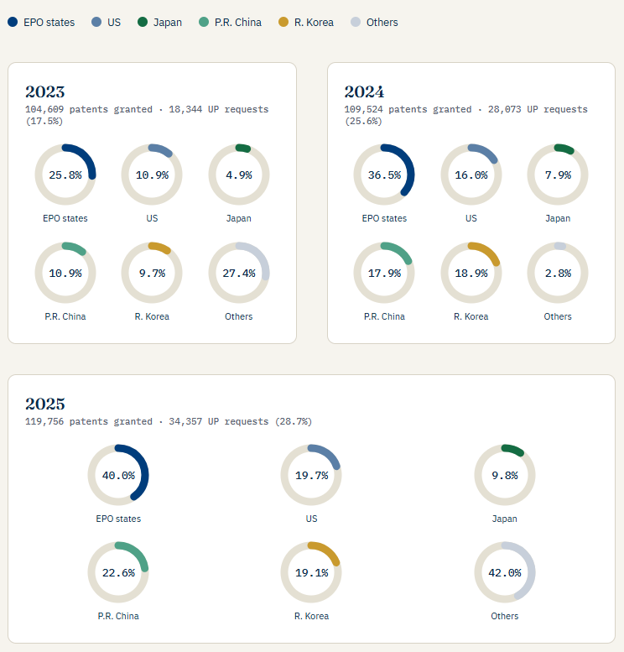
The most striking feature of the data is that uptake has increased across almost every region year on year, suggesting a broadening acceptance of the UP system among patent proprietors worldwide.
European proprietors have remained at the forefront since the system’s introduction. In 2023, requests for unitary effect were filed for 25.8% of European patents granted to proprietors from EPC member states. By 2025, that figure had risen to 40.0%, meaning that two out of every five European patents granted to EPC-state proprietors obtained unitary protection.
This early and sustained interest is perhaps unsurprising. For European businesses it common to sell (and therefore protect) inventions across multiple EU member states, making the broad territorial coverage offered by a single UP particularly attractive.
There are also clear cost benefits. Filing a request can offer significant savings for any proprietor who would have otherwise validated their European patent in several EPO states: a UP requires only a single translation, avoids the validation fee that comes with each separate national validation and requires only one renewal fee per year. These savings may explain the strong uptake amongst European proprietors from the outset.
However, this trend is not confined to Europe. US proprietors have also shown growing confidence in the system, with uptake rates increasing from 10.9% in 2023 to 19.7% in 2025. Although this remains below the level seen among EPC state proprietors, the rate has almost doubled in just two years. This suggests that, while many US patentees may still prefer the perceived certainty of traditional national validation, an increasing proportion are willing to take advantage of the broader protection and enforcement options offered by the UPC.
Chinese and South Korean proprietors have demonstrated similar strategies. Much like their US counterparts, Chinese and South Korean proprietors were initially opting for fewer UP requests than proprietors in the EPC states, but their interest is now increasing. In China, uptake increased from 10.9% in 2023 to 22.6% in 2025, representing more than a doubling over the period. In South Korea uptake rose from 9.7% to 19.1% over the same timeframe. These figures suggest that awareness of, and confidence in, the new system is expanding well beyond Europe.
Japanese proprietors have historically been more cautious, but the data nevertheless indicates a gradual increase in adoption. Uptake rose from 4.9% in 2023 to 9.8% in 2025. Although this remains comparatively modest, the direction of travel is clear and mirrors the broader trend seen across other major filing regions.
Taken as a whole, the data paints a consistent picture. While adoption rates vary between jurisdictions, proprietors from every major region are making increasing use of the Unitary Patent. Three years after its introduction, the Unitary Patent appears to be moving steadily to an increasingly mainstream component of European patent protection.
If you would like to discuss any of the UPC-related issues discussed in this article, including your opt-out strategy for pending European patent applications, please speak to your usual Barker Brettell patent attorney or contact us.